
Most of the conversation around thin or off-topic content stops at the page itself. The page doesn’t rank, the page doesn’t convert, so you delete it and move on. That framing misses the part that actually costs you money. The real damage from years of scaled, off-topic content isn’t that those pages underperform. It’s what they do to the rest of your site, specifically to the handful of pages that drive revenue and the queries you actually need to win.
I’ve consulted with several websites that have gotten hit by Google’s Helpful Content Updates and then again when AI Overviews rolled out. The pattern is almost always identical. They spent years cranking out top-of-funnel content to chase traffic, the traffic showed up, everyone celebrated, and then it evaporated. When you trace it back, the content pulling the most traffic and the most search queries turned out to be responsible for almost none of the revenue. This post is about that downstream effect, because that’s where the actual business impact lives.
Why Is the Helpful Content System So Dangerous?
The single most important thing to understand is that the Helpful Content system doesn’t grade your site page by page. Google folded it into the core ranking algorithm in March 2024, and the classifier works at the site level. Google’s own wording is that any content, not just the unhelpful content, on a site with relatively high amounts of unhelpful content overall is less likely to do well in Search.
Read that twice, because it’s the whole ballgame. Your good pages get suppressed because of your bad pages. The classifier is scoring the entire domain, so if a big enough chunk of your content reads as thin or written for robots instead of people, it can drag down rankings sitewide, including the pages you’d never want touched. I’ve seen recovery practitioners describe sites with 200 solid pages losing visibility because they also shipped 500 pages of low-effort filler. That tracks with what I’ve seen firsthand.
That is the downstream effect in its purest form. The off-topic content isn’t quietly sitting in a corner being mediocre. It’s actively pulling down the pages that pay your bills. You didn’t just dilute one page. You lowered the ceiling for everything.
What the Google API Leak Actually Told Us
When the Google Content Warehouse API documentation leaked in 2024, it put mechanical detail behind what the Helpful Content updates had already been doing in spirit. Two attributes are worth your time. siteFocusScore is a number indicating how focused a site is on a single topic. siteRadius measures how far a given page’s embeddings drift from the site’s embedding, where a smaller radius means the pages cluster tightly around one central theme.
The mechanism is vectorization. Google appears to vectorize both pages and entire sites, then compares the page embeddings against the site embedding to see how far off-topic any given page sits. So every article you publish gets measured against the mathematical center of what your whole site is about. Publish a few hundred pages far from that center and you do two things at once: you widen the radius and you drag the center itself off to the side. This is the same site-level signal I dug into in Topic-First SEO, where the unit of analysis stops being the page and becomes the topic.
Now the caveat I always give clients, because it matters. The leak shows what Google collects and computes. It is not proof of a live ranking weight with a published coefficient. The documents tell us what data Google gathers and give strong hints about what it cares about, nothing more. I treat siteFocusScore and siteRadius as confirmation of what the Helpful Content updates already proved in the SERPs, not as gospel. The behavior in the rankings is the real evidence. The leak just gave that behavior a name, which is honestly useful when you’re trying to explain to a CMO why their blog is a liability.
How Big Is the Demotion, Really?
This is not a rounding error you can shrug off. Cutting low-quality content was a stated goal, and it was done at scale. By Google’s own account, the March 2024 core update and the efforts before it were aimed at reducing low-quality, unoriginal content in search by around 40%.
The sites caught in that net lost real money. Reports put traffic losses for content-bloated sites somewhere between 20% and 60%, with recovery running two to six months of consistent work, assuming it comes back at all. Some verticals got hit far harder.
HubSpot was arguably the most studied example of Helpful Content demotions. Their site traffic prior to HCU was estimated to receive up to 24 million visits per month at their peak and ended up dropping to 6 million. That traffic largely came from scaled content that had nothing to do with their business model or industry at all. It was traffic for traffic’s sake. Some people’s idea of “top-of-funnel” content appeared to be publish whatever you want as long as it results in clicks, and if you even get one customer that’s good.

The Traffic Was a Mirage the Entire Time
Here’s the part that makes this so hard to catch from inside a company. The off-topic content works for a while. It ranks, it pulls traffic, the GA4 dashboard looks healthy, and the content team feels productive. Everybody reads traffic as value.
The honest truth is that the traffic was never going to convert. Someone searching for how to create emojis into Google is not your buyer. They read the article, they bounce, and they were never going to purchase anything from you. The traffic problem and the topical drift problem are the same problem measured two different ways. Every post you published to chase a query unrelated to your business is a page sitting way out at the edge of your siteRadius. So the non-converting traffic isn’t just wasted acquisition cost, it’s the visible symptom of a sitewide relevance problem that Google appears to be scoring directly.
Executives generally assume that traffic is free money and that they’d have gotten it anyway. That point of view is not entirely wrong, but it falls apart the moment you map search queries to actual revenue instead of to raw sessions. When you do that the picture flips hard. I’ve worked on sites where the clear majority of organic traffic and search queries came from content responsible for a tiny sliver of the business. That’s not a content strategy. That’s a tax you’ve been paying on your own domain, and the bill comes due the day a core update decides your site is mostly noise.
How AI Overviews Raised the Stakes on Your Money Queries
For years almost any ranking was worth having, because the click came back to your own site. AI Overviews and AI search changed that math, and they changed it in a way that makes topical focus matter more, not less. I unpacked the demand-side of this shift in AI Search Broke the Funnel; this is the supply-side consequence for your own domain.
Start with the mechanical link between ranking and getting cited. ChatGPT reportedly leans on Bing’s index for the large majority of its retrieval, and Google’s AI Overviews cite organic results the overwhelming majority of the time. The practical translation is simple: if you don’t rank, you don’t get cited. The organic ranking is your entry ticket into the AI answer. So anything dragging down your rankings on your money queries is also quietly locking you out of the AI Overview for those exact queries. You lose twice.
Now the part that should reorder your priorities. Raw domain size is not what wins AI citations. Topical relevance beats raw domain authority, and a focused niche site can out-cite a giant publisher when its content is more contextually aligned with the query. The research I’ve seen points to brand search demand and entity recognition, not backlink volume, as the strongest predictors of how often a brand gets cited across AI platforms. This lines up with what I’ve been seeing in my own LLM brand monitoring work, where what these models think your site is about drives whether they mention you at all.
Put those two things together and the conclusion is unavoidable. AI search rewards the exact thing that off-topic content destroys, which is a tight, recognizable topical identity. A focused site that ranks for its core queries is positioned to get cited in the AI answer for those queries. A bloated site that’s been classified as mostly unhelpful is fighting just to rank, and it loses the citation by default. The off-topic articles aren’t only failing to convert anymore. They’re feeding a confused signal to both Google’s classifier and the AI’s read of what your brand even is, at the precise moment AI search is deciding whether you’re worth mentioning.
Content Pruning Is the Fix, and Every Cut Is a Decision About Traffic Quality
The remedy for most of these sites is content pruning. You find the off-topic, low-value content that drives little or no revenue, and you remove it, consolidate it, or rewrite it to serve your core topic. The goal is to pull your siteRadius back in and raise your siteFocusScore by making the site overwhelmingly about the thing your business actually does. This also happens to be the recovery path Google itself points to: consolidate thin pages into comprehensive resources with 301 redirects, and remove the zero-impression, zero-backlink, zero-value pages that are dragging your sitewide quality down.
A lot of SEOs are scared to delete content because they were trained to believe more pages is always better. That was true in 2010. It hasn’t been true for a long time. Cutting a few hundred pages of irrelevant filler can lift the rankings of the pages that actually matter, because you’ve stopped asking Google to average your good content against a mountain of garbage.
Pruning is not a blanket delete spree though, and each triage call is really a decision about traffic quality, not tidiness:
- Rewrite keeps the page but steers its relevance back toward content that can actually convert. Use it when the page has salvageable relevance to your core topic and ideally some earned links worth keeping.
- 301 redirect hands whatever equity the page earned over to a page that serves a real buyer. Use it when the page is off-topic but has links or traffic you don’t want to throw in the trash.
- Remove and let it 410 admits the traffic was never going to convert and stops the page from dragging your average relevance down. Use it for pages with no salvageable relevance, no links, and no strategic value.
You’re not deleting traffic for sport. You’re trading low-value, non-converting traffic for a tighter topical signal that lifts the pages that do convert. One thing I’ll say plainly so nobody expects magic: the Helpful Content system wants to see sustained improvement before it lifts a sitewide demotion. Recovery runs months, not a weekend. If someone promises you a bounce-back by Monday, hit the delete button on that conversation.
How to Diagnose Your Own Site
You don’t need access to Google’s internal scores to find this on your own site. The data you already have is enough:
- Run a Screaming Frog crawl on your site and embed the URLs with Gemini embeddings.
- Cross-reference traffic against revenue or lead data. The pages pulling heavy traffic that convert nothing are your prime suspects.
- Look at the spread of your search queries. Mapping queries to revenue isn’t a separate exercise from measuring your topical drift, it’s how you measure that drift without needing Google’s internal numbers. The queries bringing traffic but no revenue are the same pages pulling your topical center off-axis. If you’ve exported GSC into BigQuery you can do this across hundreds of thousands of rows instead of the 1,000 the UI caps you at, which is the only way to see the real shape of it.
- Map your topic clusters and see which content sits inside a cluster that supports the business versus which content is orphaned filler nobody links to. You can also use QueryDrift to visualize and measure the semantic relevance of your topic clusters and search queries.
- Confirm the timing. Line your traffic up against the update dates of August 2022, September 2023, and March 2024. A sharp drop within days of one of those, especially a sitewide one rather than a few pages, tells you which classifier you’re dealing with.
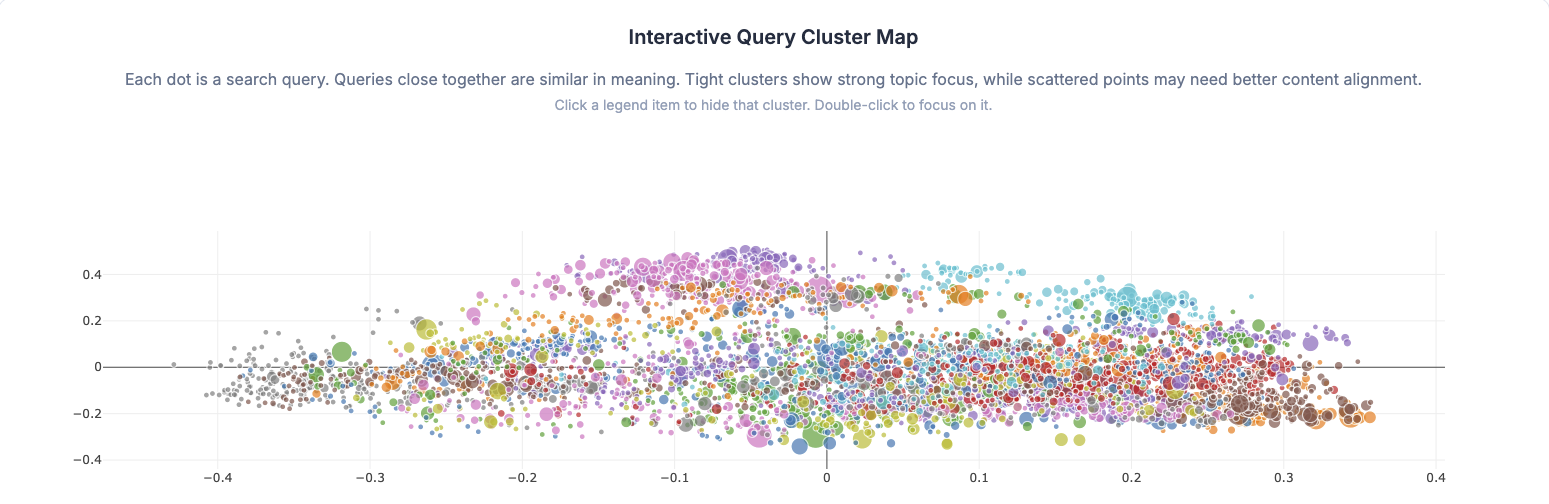
The pattern usually jumps right out once you put traffic and revenue side by side. More often than not, the articles everyone was proudest of are the ones quietly doing the damage to the pages nobody was watching.
The Takeaway
Volume was never the strategy. Relevance is. Years of scaled top-of-funnel content build up a body of work that looks like an asset in your analytics and behaves like an anchor in the algorithm. The downstream effect of all that off-topic content isn’t that the off-topic pages underperform. It’s that they suppress the rankings of your revenue pages and lock you out of the AI citations for the queries that actually matter to your business.
The Helpful Content Updates and AI Overviews didn’t create this problem. They just stopped rewarding the thing that was hiding it, and they raised the price of leaving it unfixed.
If you suspect your blog is dragging down the rest of your site and you’re not sure what to keep, what to consolidate, and what to cut, feel free to reach out. Sorting out which content drives revenue and which is quietly taxing the rest of the site is exactly the kind of work I do.
Think Your Blog Is Dragging Down the Rest of Your Site? Let’s Talk.
Sources
- Search Engine Land, “Unpacking Google’s massive search documentation leak” (
siteFocusScore,siteRadius, page and site embeddings in the scoring function). - Search Engine Land, “HUGE Google Search document leak reveals inner workings of ranking algorithm” (vectorization of pages and sites).
- Search Engine Land, “HubSpot’s SEO collapse: What went wrong and why?”