Entity SEO is won by systematic entity gap analysis — not keyword density.
| Keyword SEO | Entity SEO | |
|---|---|---|
| Unit of focus | Exact-match keywords and variants | Entities and their relationships |
| Optimization signal | Keyword frequency, density, placement | Co-occurrence, disambiguation, schema context |
| Content strategy | Target keyword variations | Cover the entity graph around your topic |
| Structured data | Basic (Article, Product) | Organization, Person, SameAs, linked-data references |
| Where the gain shows up | Ranking positions | Knowledge panels, AI Overview citations, featured snippets |
What Is Entity SEO?
Entity SEO is the strategic approach to optimizing content for how search engines understand and categorize real-world entities—people, places, things, concepts, and their relationships. Unlike traditional keyword-focused SEO, Entity SEO emphasizes semantic relationships and contextual meaning within Google's Knowledge Graph.
An entity represents a distinct, well-defined object or concept that exists independently. For example, "The SEO Consultant.ai LLC" is an entity (a business), "Richard Wong" is an entity (a person), and "Entity SEO" itself is an entity (a concept). The power lies in how these entities connect and relate to each other within the broader web of knowledge.
However, simply identifying a string like “Jaguar” isn’t enough. This leads to the fundamental challenge of entity disambiguation—the process search engines use to distinguish between different entities with the same name (e.g., the car brand vs. the animal). Without clear context, the wrong meaning can be inferred, making semantic clarity a primary goal of any effective entity strategy.
Why Entity SEO Is Critical for Modern Search Success
The Knowledge Graph Revolution
Google's Knowledge Graph contains billions of entities and trillions of connections between them. When you search for information, Google doesn't just match keywords—it understands the entities involved and their relationships to provide contextually relevant results. This shift means that content optimized for entity recognition gains significant advantages in:
- Search result prominence through featured snippets and knowledge panels
- AI Overview inclusion as Google increasingly relies on entity understanding for AI-generated responses
- Semantic search ranking where context and meaning outweigh keyword density
- Future-proofing as search continues evolving toward natural language understanding
The Competitive Reality
From my analysis of thousands of websites across various industries, businesses that fail to implement Entity SEO consistently lose market share to competitors who embrace semantic optimization. The gap is widening rapidly as AI-powered search features become more prevalent.
The Four Pillars of Entity SEO Implementation
1. Entity Identification and Mapping
The foundation of effective Entity SEO starts with comprehensive entity identification. This involves:
- Content Entity Extraction: Using natural language processing to identify all entities currently present in your content, measuring their document salience (importance within the text) and their relationships to your target queries.
- Competitive Entity Gap Analysis: Analyzing competitor content to identify entities they're leveraging that you're missing—entities that could strengthen your topical authority and query relevance.
- Entity Relationship Mapping: Understanding how entities connect to each other and to specific content sections, revealing opportunities for semantic optimization.
2. Strategic Entity Implementation
Once you've identified entity gaps, strategic implementation becomes crucial:
- Semantic Integration: Adding missing entities isn't about keyword stuffing—it's about natural integration that enhances content meaning and user value.
- Content Section Optimization: Understanding which content sections have the highest semantic relevance for specific entities, ensuring optimal placement for maximum impact.
- Topical Authority Building: Creating comprehensive entity coverage that establishes your brand as an authoritative source within your domain.
3. Structured Data Excellence
Structured data serves as the bridge between your content and search engines' entity understanding:
- Schema Markup Implementation: Using precise schema types (Organization, Person, Article, HowTo, FAQPage) to explicitly communicate entity information to search engines.
- Entity Property Declaration: Clearly defining entity attributes, relationships, and contextual information through structured data.
- Knowledge Graph Population: Providing search engines with the structured information they need to include your entities in their knowledge repositories.
4. Continuous Optimization and Measurement
Entity SEO requires ongoing refinement based on performance data and algorithmic changes:
- Entity Performance Tracking: Monitoring how well your entities perform in search results and AI overviews.
- Relationship Refinement: Continuously improving entity relationships and contextual connections.
- Competitive Monitoring: Staying ahead of competitor entity strategies and identifying new optimization opportunities.
Entity Gap Analysis Methodology
Through years of performance marketing leadership and hands-on SEO experience, I've developed a systematic approach to entity optimization that I use with clients at The SEO Consultant.ai. This methodology combines advanced NLP analysis with practical implementation strategies.
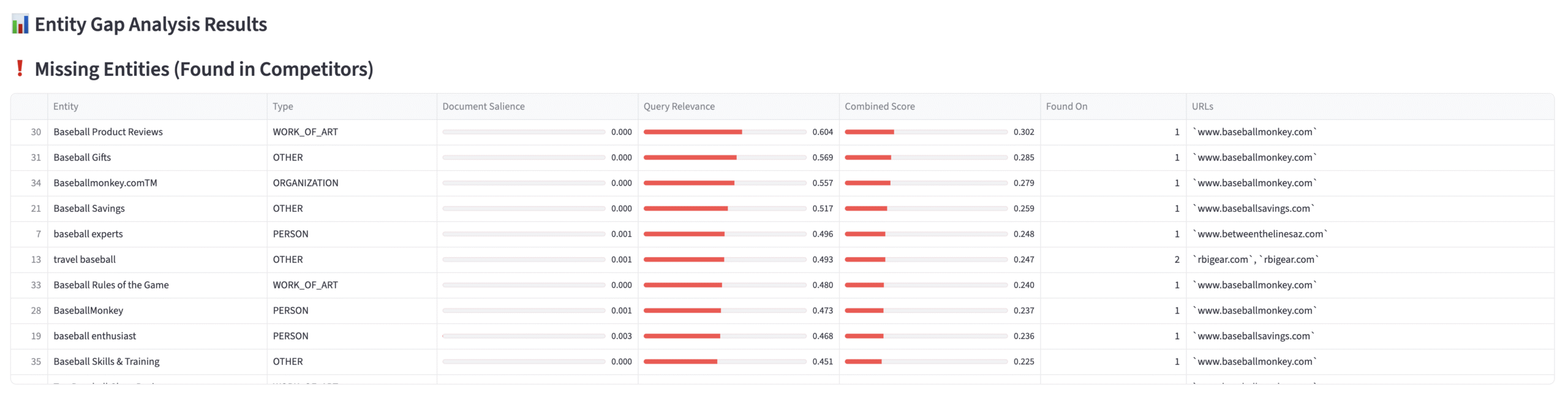
The Entity Gap Analysis Process
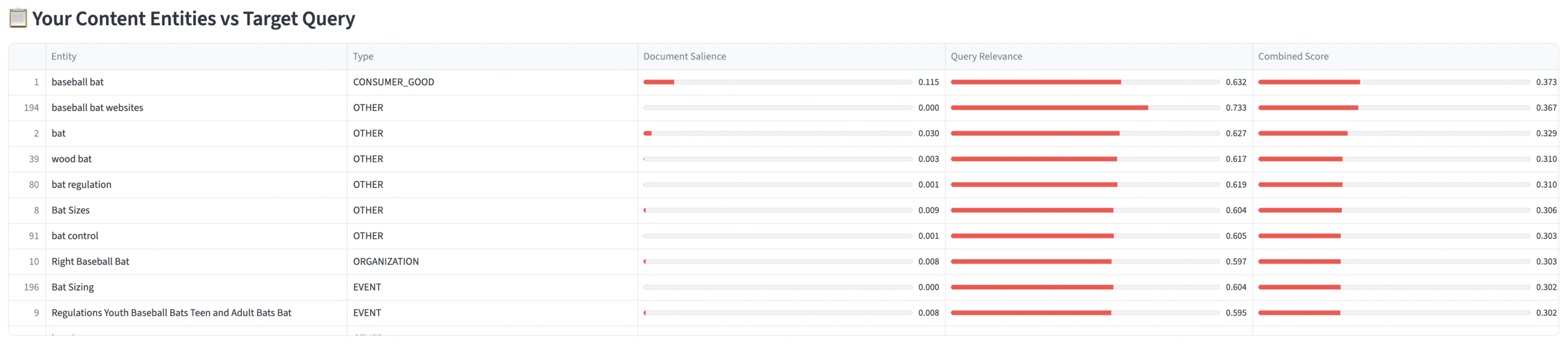
Step 1: Content Entity Extraction I utilize Google Cloud's Natural Language API and the spaCy Python library to extract entities from your content, measuring both document salience and entity types. This provides a comprehensive baseline of your current entity coverage.
Step 2: Competitive Entity Intelligence By analyzing competitor content through the same NLP process, I identify entities that competitors are leveraging effectively but that are missing from your content. This reveals immediate optimization opportunities.
Step 3: Query Relevance Scoring Using semantic similarity analysis, I calculate how relevant each entity is to your target search queries. This ensures that entity additions directly support your search visibility goals.
Step 4: Content Section Mapping Through passage-level analysis, I determine which sections of your content have the highest semantic relevance for specific entities. This pinpoints optimal insertion locations for maximum impact.
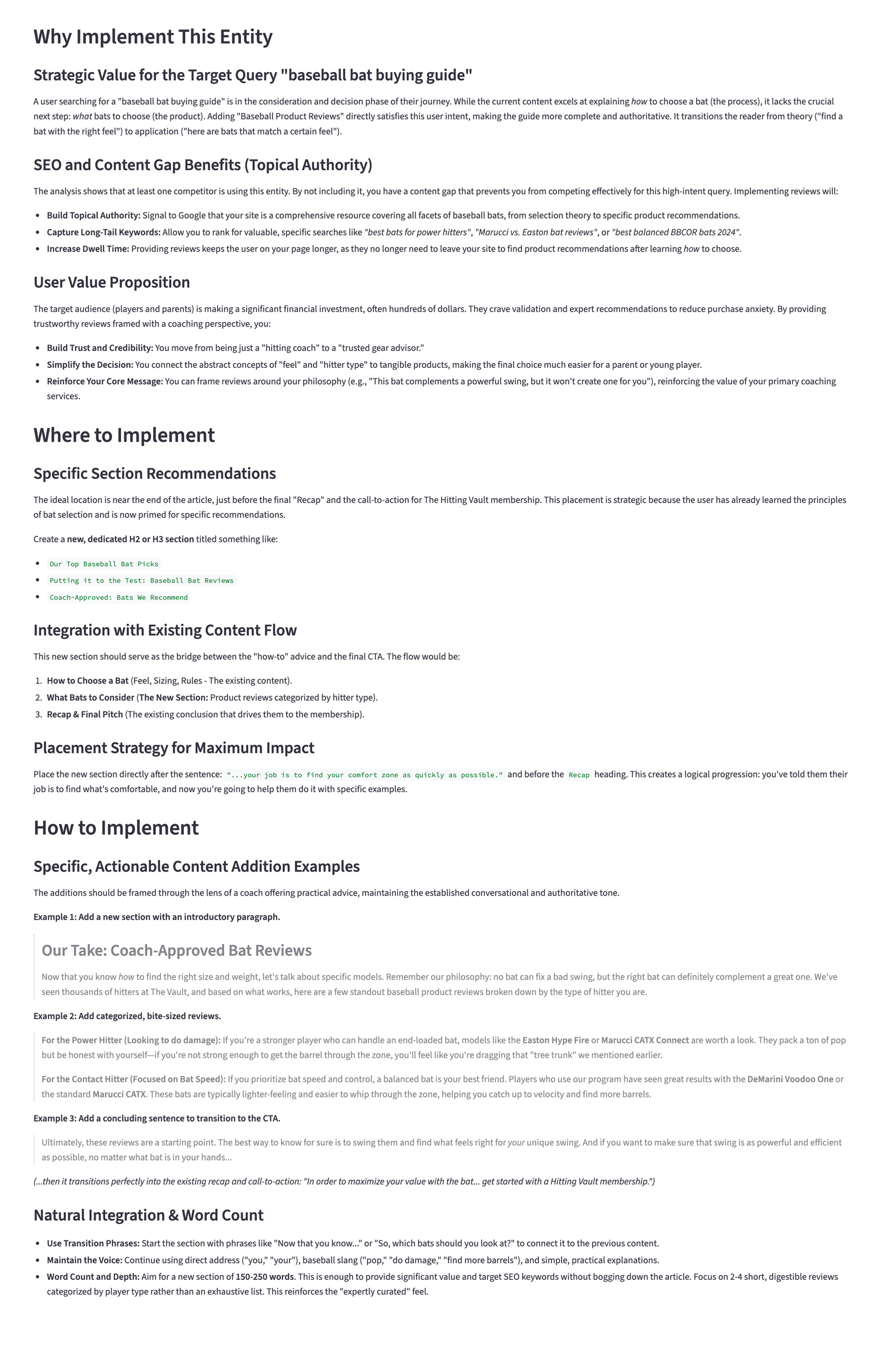
Step 5: Implementation Strategy Development I provide specific, actionable recommendations for integrating missing entities, including exact placement suggestions and natural integration techniques that maintain your content's voice and flow.
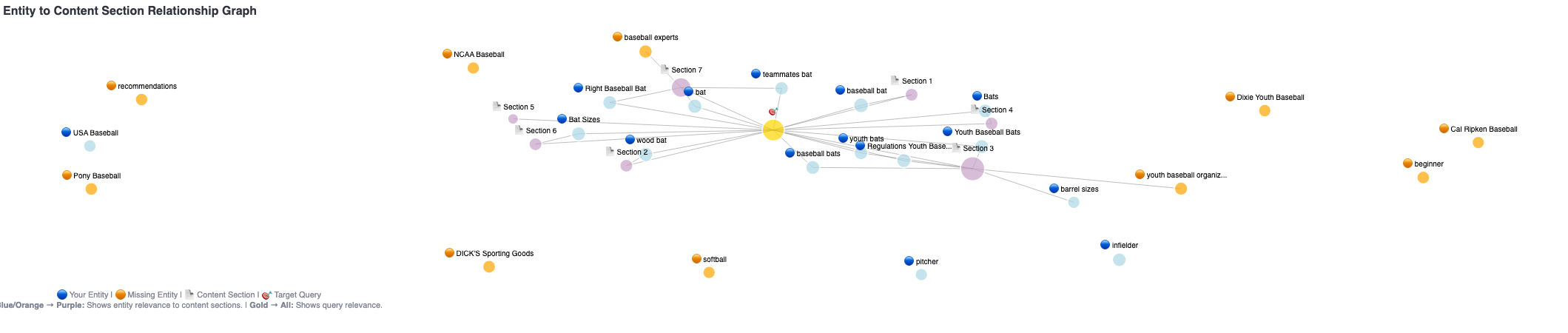
Advanced Entity Relationship Visualization
One of my approaches involves creating entity relationship graphs that visualize how your entities connect to your content sections and target queries. This provides a clear roadmap for optimization, showing exactly where entity gaps exist and how to fill them strategically.
The visualization reveals:
- Which content sections are entity-rich versus entity-sparse
- How missing entities would integrate with your existing content structure
- The semantic connections between your target queries and entity opportunities
- Priority areas for optimization based on combined relevance scores
Practical Entity SEO Implementation
Content Optimization Strategies
Natural Language Integration: When adding entities to content, focus on natural integration that enhances readability and user value. Forced entity insertion often backfires in both user experience and search performance.
Contextual Relationship Building: Ensure that entities are presented within meaningful contexts that help search engines understand their relevance to your overall topic and target audience.
Comprehensive Entity Coverage: Rather than superficial mentions, provide substantial, valuable information about entities to establish genuine expertise and authority.
Technical Implementation
Leveraging Entity-Focused Schema Markup for Authority and Relevance
One question I frequently encounter from businesses is: how can they leverage entity-focused schema markup to enhance search engine understanding of their authority and relevance in modern AI-driven SEO landscapes?
The answer lies in strategic structured data implementation that goes beyond basic markup. This isn't about simply adding schema to check a box—it's about strategically using organization and person schemas to mark key entities and their connections within your content ecosystem.
Schema Markup Precision
From my work with clients at The SEO Consultant.ai, effective schema implementation requires a comprehensive approach. Start with these foundational elements:
- Organization schema for your business entity with specific services, location, and contact information
- Person schema for key individuals like founders, executives, or subject matter experts
- Article schema for your content pieces to establish topical coverage
- LocalBusiness schema if you have physical locations
- Service schema to explicitly define your offerings
Each schema type helps search engines understand different facets of your entity ecosystem and how they connect to user queries.
Entity Property Declaration and Relationships
The strategic advantage comes from clearly defining entity attributes, relationships, and contextual information through your structured data.
When you markup an article, don't just identify it as an article—connect it to:
- Your organization entity
- The author entity
- Related concept entities through proper schema properties
These connections reinforce your topical authority by showing search engines the comprehensive network of entity relationships your business maintains.
I've seen significant improvements in AI Overview inclusion and featured snippet prominence when businesses implement comprehensive entity-focused schema that maps these relationships explicitly. Search engines don't have to guess about your authority—you're telling them directly through structured data.
Another Way to Implement Entity Schema
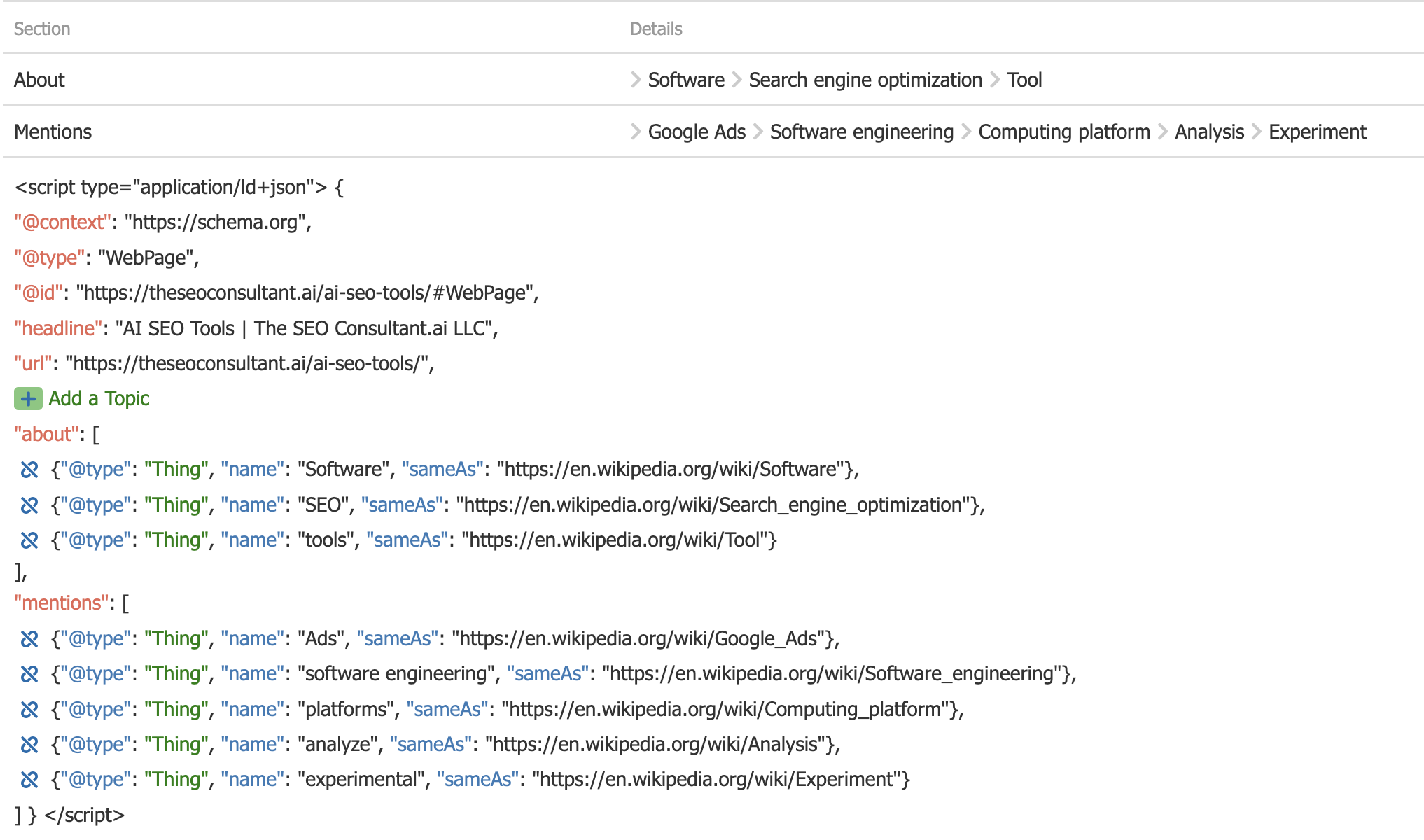
Another effective approach I use is leveraging InLinks for entity schema implementation. InLinks maps entities to Wikipedia URLs via SameAs schema, which helps search engines validate your entities against their knowledge graph.
This external validation reinforces entity recognition and can accelerate how quickly search engines establish your topical authority. The SameAs property creates explicit connections between your content entities and recognized knowledge sources, which is particularly valuable for newer websites or businesses working to establish domain authority.
Internal Linking Strategy
Create internal linking patterns that reinforce entity relationships and help search engines understand the connections between related content pieces.
When I write about Entity SEO on one page and then reference semantic search strategies on another, those internal links signal to search engines that these entities are closely related within my content ecosystem. This pattern recognition contributes to how search engines assess your topical coverage and authority.
Content Architecture
Structure your site architecture to support entity-focused content organization, making it easier for search engines to understand your entity ecosystem.
This might mean creating pillar pages for core entity topics with supporting content that explores related entities in depth. The hierarchical relationship between these pages, reinforced through both internal linking and schema markup, helps search engines map your entity universe accurately.
Measuring Entity SEO Success
Key Performance Indicators
Entity Visibility Metrics: Track how often your entities appear in knowledge panels, featured snippets, and AI overviews.
Semantic Search Performance: Monitor rankings for queries where search engines need to understand context and entity relationships rather than just keyword matching.
Topical Authority Indicators: Measure improvements in rankings across related entity clusters, indicating stronger topical authority recognition.
User Engagement Quality: Analyze user behavior metrics to ensure that entity-optimized content provides genuine value and meets user intent.
Advanced Analytics Integration
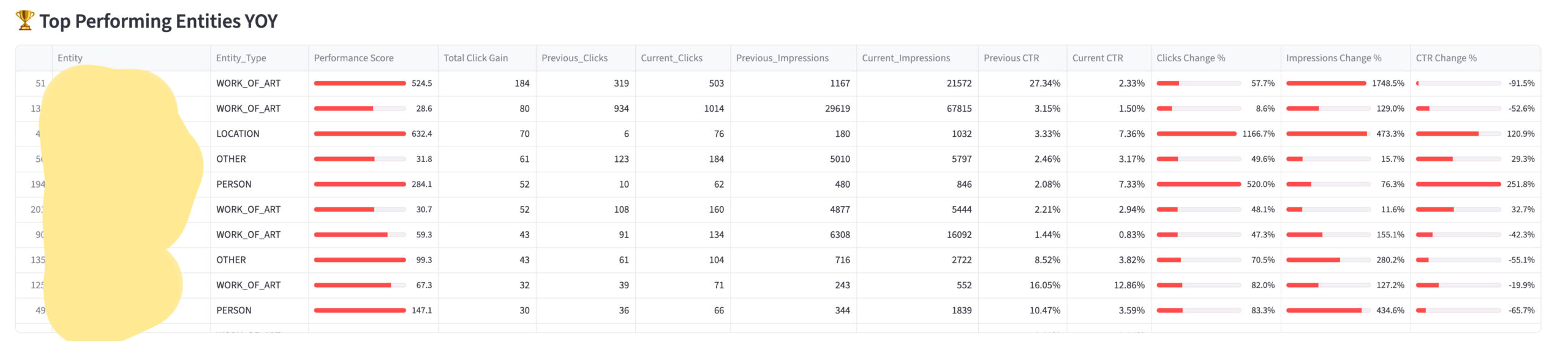
I recommend integrating Google Search Console data with BigQuery and named entity recognition (NER) for advanced entity performance analysis. This allows for deeper insights into how your entity optimization efforts impact search visibility across thousands of query variations.
The Future of Entity SEO
AI Search Evolution
As AI-powered search features continue expanding, entity understanding becomes even more critical. Search engines increasingly rely on entity knowledge to generate AI overviews, answer complex queries, and provide personalized results.
Multimodal Entity Recognition: Future optimization will need to consider how entities are represented across text, images, video, and audio content as AI systems become more sophisticated in multimodal understanding.
Conversational Entity Context: With the rise of conversational AI search interfaces, content must be optimized for how entities are understood and referenced in natural dialogue rather than keyword-based queries.
Staying Ahead of the Curve
The businesses that succeed in the evolving search landscape will be those that embrace entity-focused optimization early and comprehensively. This requires both strategic thinking and technical execution—exactly the combination that The SEO Consultant.ai provides for our clients.
Getting Started With Entity SEO
Immediate Action Steps
- Conduct an Entity Audit: Analyze your current content to understand your entity coverage and identify immediate gaps.
- Implement Core Schema Markup: Ensure your website has proper Organization, Person, and content-specific schema markup.
- Analyze Your Top Competitors: Identify the entities they're leveraging that you're missing, particularly those relevant to your target queries.
- Create an Entity Implementation Plan: Prioritize entity additions based on query relevance and implementation feasibility.
- Monitor and Refine: Establish tracking systems to measure entity SEO performance and continuously optimize your approach.
Advanced Entity Optimization
For businesses ready to implement comprehensive entity strategies, my Entity Gap Analysis methodology provides the detailed insights needed for significant search performance improvements. This approach has driven double-digit business growth by identifying and filling critical entity gaps that competitors miss.
The Semantic Search Advantage
Entity SEO represents the evolution from keyword optimization to meaning optimization. As search engines become more sophisticated in understanding context, relationships, and user intent, businesses that master entity optimization gain significant competitive advantages.
The shift toward semantic search isn't coming—it's here. Google's AI overviews, AEO/GEO, and contextual search results all depend on entity understanding. The question isn't whether to implement Entity SEO, but how quickly and effectively you can execute it.
At The SEO Consultant.ai, I've spent years focusing on entity optimization methodologies that deliver measurable results. The combination of advanced NLP analysis, competitive intelligence, and strategic implementation provides the comprehensive approach needed to succeed in semantic search.
The future of SEO is semantic, entity-focused, and AI-driven. The businesses that embrace this reality today will be the ones that dominate search visibility tomorrow.