Here is the state of AI search reporting in July 2026. Google shipped its Search Generative AI performance report on June 3rd. It tells you how many times a URL from your site appeared in a generative AI feature like AI Overviews or AI Mode. That’s the metric. Singular. You can slice it by page, country, device and date, and that is the entire report. There are no queries. There are no clicks, no CTR, no position. The usual 1,000-row cap still applies. And it’s rolling out to a subset of sites, which means a lot of us (me included) are reading about it rather than using it.
So you can learn that a page showed up in an AI answer 400 times last month. You cannot learn what anybody asked, what the answer said, or why that page and not the one next to it. It’s a speedometer with the numbers filed off. I’ve complained about Search Console’s blind spots before, and I’ll take an impressions-only report over nothing. But nobody should mistake it for insight.
Meanwhile, Bing has been providing data to publishers that actually gives some usable insights.
What Bing Actually Gives You
Bing Webmaster Tools put its AI Performance report into public preview in February 2026 and expanded it in June. What you get, for free, exported as CSV:
- Grounding queries: the actual queries Copilot generated internally to go find source material. Not the user’s prompt: the retrieval query the model wrote for itself when it decided it needed evidence.
- Citations: how many times your content was cited in a generated answer, per query and per URL.
- Citation share: your slice of all citations shown for that grounding query, across every site.
- Intents and topics: Bing’s own classification of each grounding query (Informational, Commercial, Navigational, and so on) and a thematic grouping on top.
Read that list again next to Google’s. Google gives you an impression count. Bing tells you what the machine was looking for, which of your URLs it grabbed, and how much of the citation space you took. That’s not a small gap in reporting quality. That’s the difference between knowing you were in the room and knowing what was said.
The obvious objection is that Bing isn’t Google, and it isn’t. I’ll deal with that honestly at the end. But right now Bing’s AI surface is the only one on the open web that will tell you, by URL, what a retrieval-augmented model went looking for and what it cited. When that’s the only lamp on the street, you look under it.
A Citation Count Is Not an Insight
Here’s where most people stop. They open the AI Performance report, sort by citations, look at the top ten URLs, and feel informed. That’s a vanity read. Knowing your homepage got 5,000 citations tells you nothing you can act on, because you have no idea whether that’s a lot, whether it’s proportionate, or whether it’s the page you’d have wanted cited.
The insight isn’t in either report. It’s in the difference between them. AI citations on one side, organic impressions on the other, and the question that matters: where do these two surfaces disagree about what my best content is?
So I recently built a tool that answers exactly that. It takes the four Bing exports (AI Page Stats, AI Search Queries, Page Traffic, Keyword) and compares the AI surface against the organic surface at the page, query and topic level. It’s a local Streamlit app I’ve been prototyping on client work; I haven’t pushed it to GitHub yet. The screenshots here are from my own photography site, so I can show you real output without showing you a client’s data.
Three Decisions That Shape the Analysis
Most of the value in a tool like this is in a handful of choices you make before you write any code. Three of them did all the work.
Compare citations to impressions, not clicks
A citation is an appearance as a source in an answer. Its organic analogue is an impression, not a click. A click is downstream engagement that the AI surface doesn’t report at all. Scoring citations against clicks compares an appearance to an engagement and punishes every page that AI loves and nobody clicks. Everything in the tool is scored against impressions. Clicks ride along as context and nothing more.
Measure share within each platform, then index one against the other
Raw counts across two surfaces aren’t comparable. My site pulled 8,612 AI citations against 10,535 organic impressions, and those two totals reflect how much each surface happened to be sampled, not how well I’m doing on either. Subtracting one from the other measures nothing.
So each surface gets normalized to its own total, and then indexed: ai_index = ai_share / impression_share × 100. An index of 100 means a page holds exactly the same share of the AI surface as it does of the organic surface. Above 100 it’s over-indexed on AI. Below 100, search likes it more than the model does. Pages with zero impressions have an infinite index, so they get held out and reported separately rather than handed a big finite number that would sort alongside real ones. Those are the pages you came for.
Cluster the two surfaces together, don’t join them on keywords
This one surprised me. My first instinct was to join AI grounding queries to organic keywords and compare them row by row. On my photography site, 64% of grounding queries matched an organic keyword. On the client site, after stopword stripping, order normalization and depluralization, the match rate was 23%.
Think about what an inner join does there: it throws away 77% of the AI data. And that missing 77% is the finding. Grounding queries are machine-authored natural language. The model writes them for retrieval, not for a search box. Organic keywords are terse and human. The two surfaces sample genuinely different query populations, and the vocabulary mismatch is the signal, not the noise.
So instead of joining, the tool embeds every AI query and every organic keyword into one vector space and clusters the union. A cluster is then the same topic on both sides, and you can finally ask “how does the AI surface treat this topic versus how search treats it” without needing the words to line up. If you’ve read my piece on topic clustering for content marketing, this is the same machinery pointed at a new problem. The keyword-level join survives in the tool as a diagnostic tab, clearly labelled as one.
What It Actually Shows You
The most useful view is the plainest: every page plotted with organic impressions on one axis and AI citations on the other, both on log scales, coloured by quadrant.
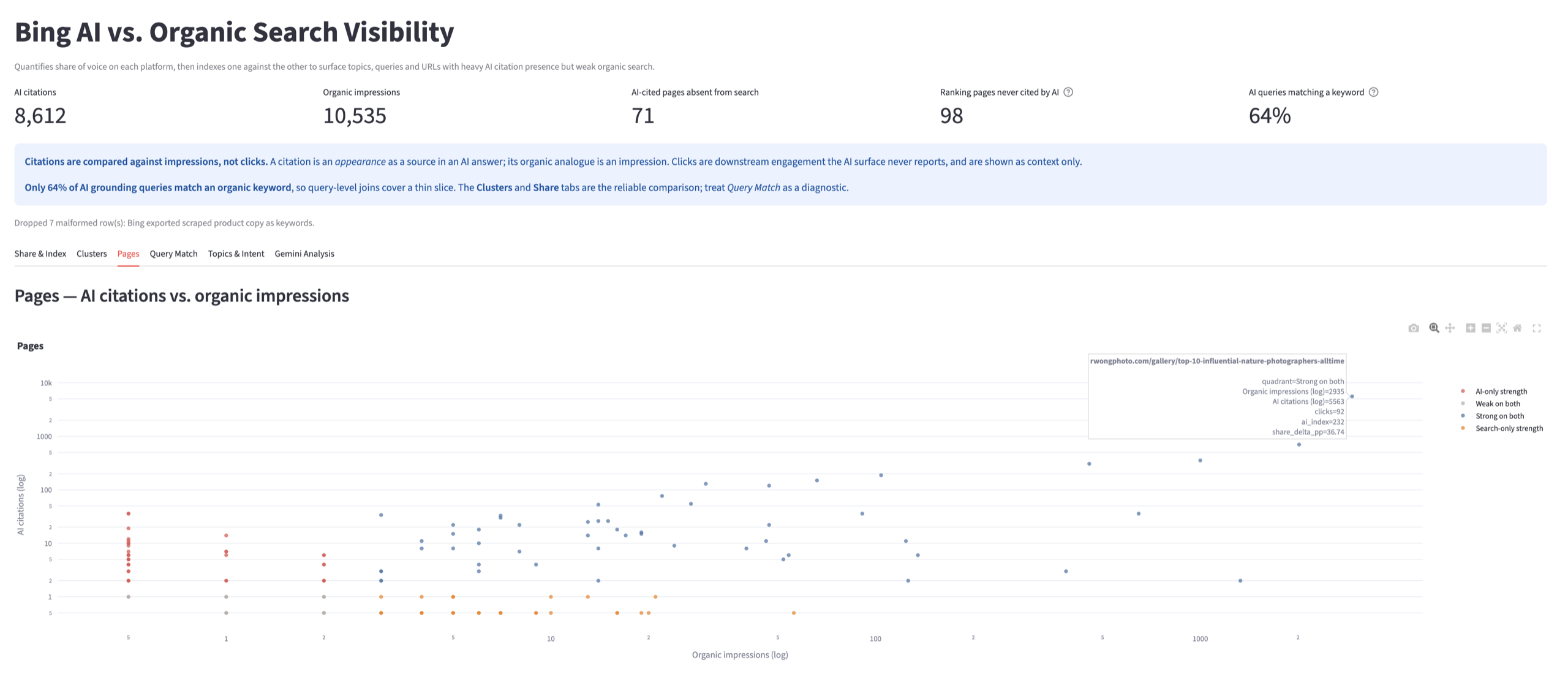
Top-right is where you want to live: cited by AI, ranking in search. So the tool files that page under “strong on both” and moves on. Look at the tooltip anyway, because it’s the most important thing in this post and it took me a minute to see what I was looking at.
The page is a list of the most influential nature photographers of all time. It is a purely informational asset, and it has been one of the largest organic traffic drivers on that site for as long as I’ve run it. I know its history cold. Here is where it stands now:
- 5,563 AI citations
- 2,935 organic impressions
- 92 clicks
The model reaches for that page nearly twice as often as search even shows it. And on the rare occasions search does show it, essentially nobody clicks. That is not two surfaces politely disagreeing about my content. That is substitution, and you can watch it happen in a single row.
The demand for that page didn’t go anywhere. It moved. “Who are the most influential nature photographers” is precisely the sort of question a generative answer resolves in place: the user asks, the model answers, and the model builds its answer out of my page. I’m still doing the work. I’m still winning the query. I’ve just been demoted from the destination to the supply chain.
What makes this row worth the whole exercise is that it shows you both halves of the zero-click problem at once. Normally you only get to see the missing click and infer the rest. That’s the whole reason I ended up building attribution models for AI-search traffic in the first place. Here the citation that replaced the click and the click that never happened are sitting in the same tooltip, and they’re both denominated in numbers.
I’ll be straight about what this data can’t do: it’s one snapshot, and these exports carry no date column, so I cannot show you the crossover actually occurring. What I have is a page whose organic history I know, and a current split running 2:1 in the model’s favour. Draw the obvious inference, then go and prove it properly. Keep the exports monthly and the trend will be there in the data instead of in my memory. I wish I’d started a year ago.
The strategic version of this is uncomfortable and worth saying plainly. On the informational half of a site, ranking is gradually becoming a supply activity rather than an acquisition one. That doesn’t make it worthless. Being the source the model is built from has real brand value, and it is certainly better than the alternative. But if you are still reporting that page’s success in sessions, you are measuring the 92 and ignoring the 5,563.
Then there’s the other corner.
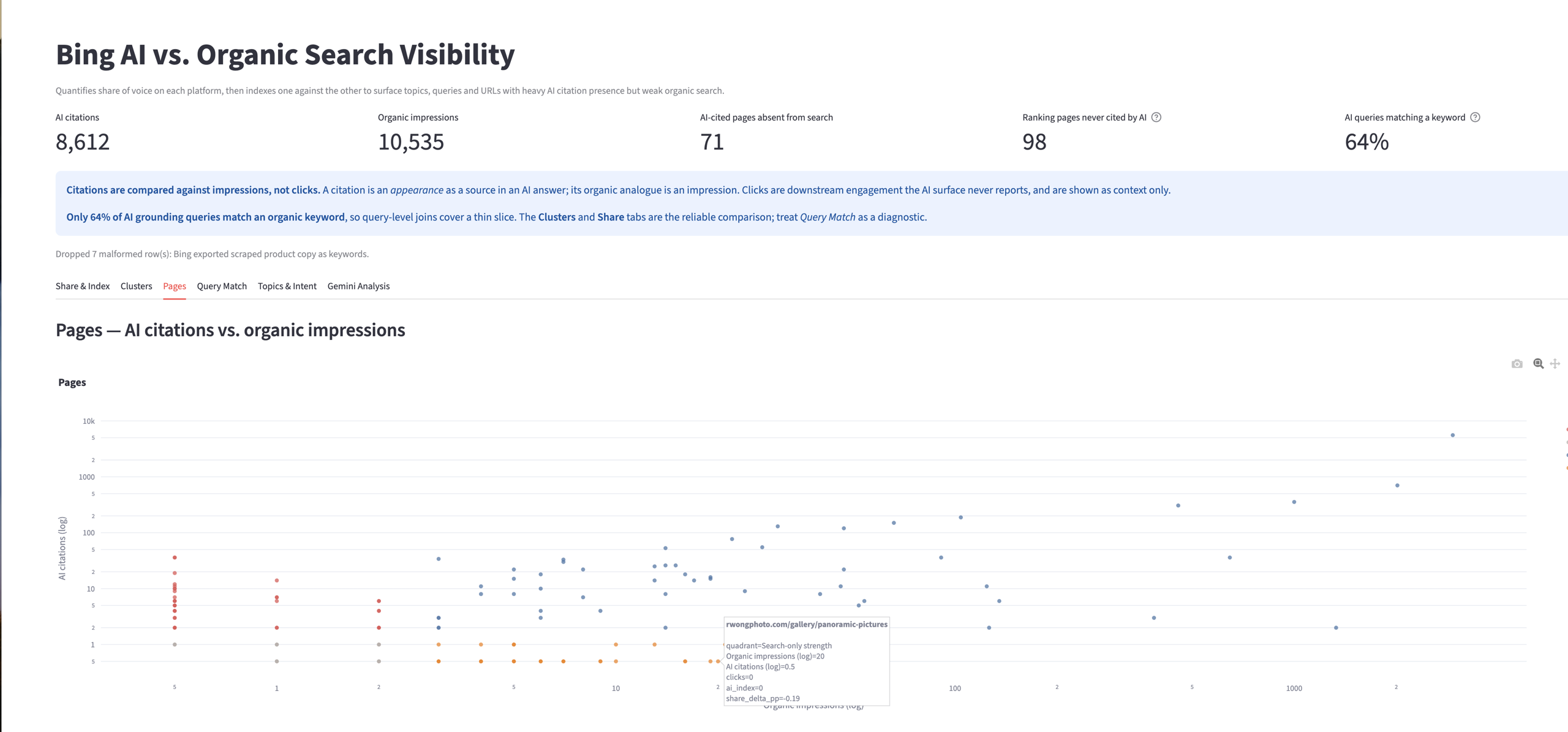
Across my site: 71 pages are cited by AI but earn no organic impressions at all, and 98 pages earn organic impressions but have never once been cited. Two populations, pointing in opposite directions, and neither one shows up in any report either search engine will hand you.
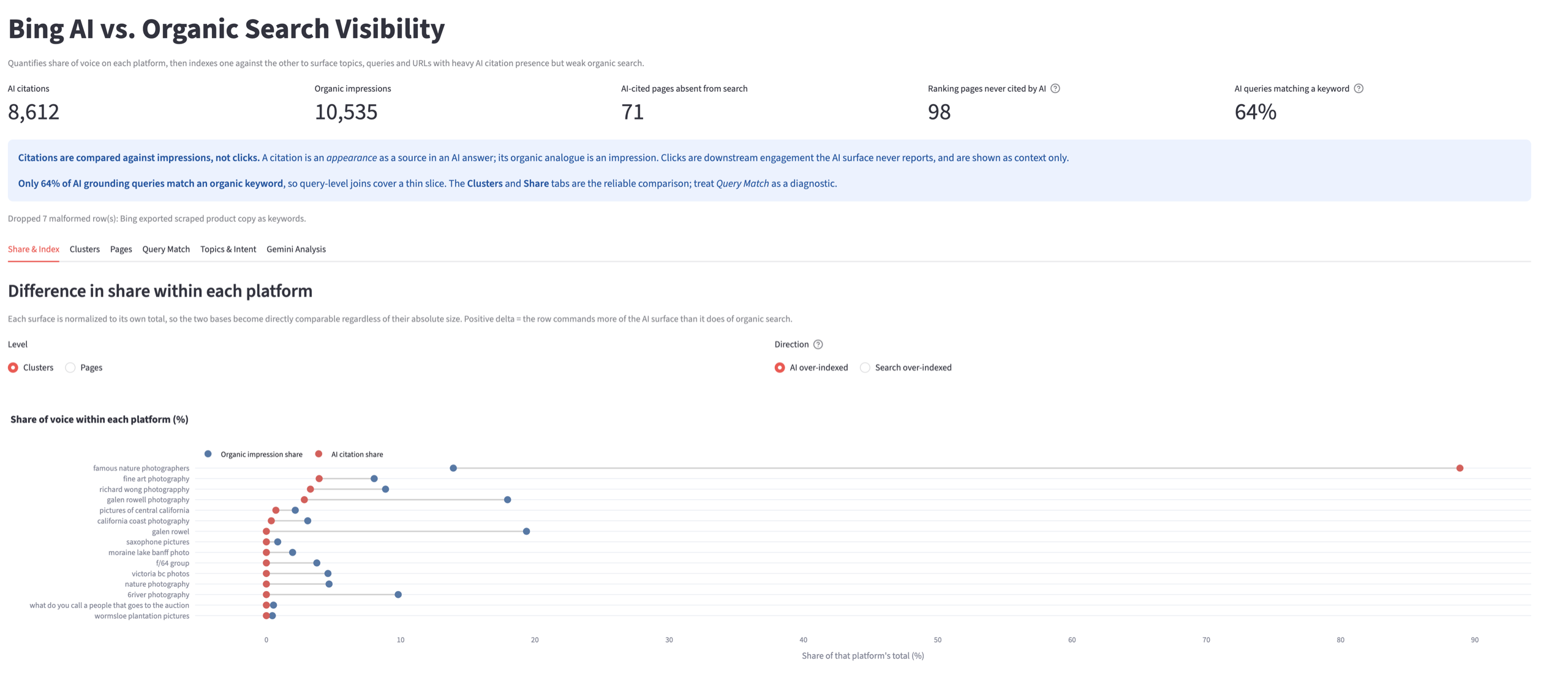
The cluster view in the hero image tells the same story at the topic level, and more brutally. One cluster (famous nature photographers) takes close to 90% of every AI citation the site earns while holding about 14% of its organic impressions. Meanwhile the clusters around a specific photographer’s name hold roughly 18 to 19% of organic impressions each and are cited by AI almost never. My site has, without my ever deciding this, become a source that AI reaches for on one topic and search reaches for on another.
The Finding: AI Was Citing the Wrong Page
Which brings me to the client engagement that started all this.
The single most heavily AI-cited URL on the domain had zero search impressions. Not low. Zero. It sat at the top of the AI citation table and was, as far as Google was concerned, invisible.
It was a reviews URL. So I pulled the grounding queries attached to it and went and read the page, and the two didn’t match at all. The model was hunting for reviews of specific product categories from a specific brand: concrete, commercially valuable, high-intent retrieval queries. The page it kept landing on was of very little functional use: the URL that structurally looked like the reviews destination, without being the page that actually answered anything.
Then it got interesting. The site did have pages that answered those queries properly. Real review content, mapped to exactly the product categories the model was asking about. Every one of them was set to noindex.
Somebody, at some point, had made an entirely defensible SEO decision. Thin-ish review pages, probably some duplication, low traffic, a crawl budget argument. Noindex them and consolidate. That’s straight out of the playbook. And in a pre-AI world it might even have been right.
What it did in an AI world was take the only content on the site that answered the model’s actual question and put a bag over its head. So the model did the next best thing: it grounded on the nearest structurally-plausible URL it was allowed to see, and cited a page that couldn’t help anybody. The brand got the citation. The citation was worthless.
The Google side had its own twist. In Search Console, the main reviews URL surfaced a handful of queries, but few of them were review-related. The genuinely review-shaped queries were attributed to the noindexed URLs, which shouldn’t be earning impressions at all if the directive were fully in force.
I want to be careful here, because this is the point where an SEO post usually overreaches. I am not claiming Google ignores noindex. The mundane explanation (lag between the directive being applied and Google reprocessing it) is almost certainly the right one, and I didn’t have the crawl history to rule it in or out. What I’m reporting is what the data showed. And the practical conclusion survives either way: the only pages on that site that answered the review queries were the pages we had told search engines to forget.
Low Search Traffic Doesn’t Mean Low Value
Generalize that and you get the part I think matters most, and it cuts against a decade of received wisdom.
We have all been trained to prune. Find the pages with no impressions, no clicks, no rankings; noindex them, redirect them, delete them. Trim the fat. Every content audit template you have ever downloaded ranks pages by organic traffic and puts a red cell next to the bottom of the list.
That audit is now measuring one of two surfaces and calling it the whole picture. A page with no search traffic may be carrying real weight in AI answers, and until you put the two reports side by side, you have no way of knowing which of your “dead” pages are actually load-bearing. On my own site, 71 URLs are cited by AI while earning no organic impressions whatsoever. Run a traffic-based prune against that site and I’d cheerfully delete pages the model relies on, then wonder why my citation share fell off a cliff.
Low search traffic is not a verdict. It’s one surface’s opinion. Get the second opinion before you start cutting.
What This Means for How You Work
The industry has settled on a name for the AI half of this, generative engine optimization, or GEO. I still call it AI Search, because that is what it is, but the label matters less than the takeaway, which is boring to say and hard to do: your SEO strategy and your AI Search strategy have to be one strategy. Run them separately and they will actively sabotage each other, exactly like they did on that client site, where a textbook SEO decision destroyed the AI visibility of the only content that could have earned it. Optimizing for AI Overviews and Copilot answers is not a separate discipline bolted onto SEO. It is the same page, indexed or not, answering the same question.
Concretely, that means a few things change:
- Never make an indexation decision on organic metrics alone. Before you noindex, prune or consolidate anything, check whether AI is citing it. A noindex is now a decision about two surfaces, not one.
- Read the grounding queries, then go read the page. The gold isn’t the citation count. It’s the mismatch between what the model was hunting for and what it actually found. That gap is a content brief writing itself.
- Treat “cited but not ranking” as an opportunity, not an anomaly. The model has already told you it finds this content credible. Search hasn’t caught up. That’s the cheapest win on the board.
- Treat “ranking but never cited” as a question, not a failure. Sometimes it’s a genuine blind spot. Sometimes it’s a navigational or brand query that no AI answer has any reason to ground on. Separate those two before you go rewriting anything.
The Caveats, Honestly
Bing is not Google, and Copilot’s retrieval is not Gemini’s. I would not take a Bing citation share number to a client as a statement about their AI Overviews performance. What I will take is the structural finding: AI is citing a page that can’t answer the question, and the page that can is noindexed. That’s a fact about the site, not about the engine. Site-level truths travel between engines. Engine-level metrics don’t.
Grounding queries are also machine-authored retrieval queries, not things a human typed. They tell you what the model needed, which is genuinely useful and is not the same as keyword demand. Don’t hand them to a copywriter as a keyword list.
And the exports carry no date column at all. The only date is in the filename. So one export is a single frozen snapshot of whatever range you selected in the UI. If you want a trend, you have to keep the files. Start keeping the files.
None of that undermines the exercise. Bing is currently the only engine that will tell you what a retrieval model went looking for and which of your URLs it grabbed. Google gives you an impression count and a shrug. Until that changes, the Bing comparison is the best read available on how a machine that answers questions actually sees your site. And on my client work this month, it has been the most useful thing I’ve run.
Want to know which of your pages AI is citing, and which ones you’re about to delete by mistake?
Comparing the AI surface against the organic one is a large part of what I do now. If you want this run against your site, or you want help making sure your indexation decisions aren’t costing you citations, get in touch, or take a look at how I approach AI SEO consulting.
Sources
- Google Search Central, “Introducing Search Generative AI performance reports in Search Console” (June 3, 2026).
- Google Search Console Help, “Generative AI performance report (Search)”: impressions only; pages, countries, devices and dates; standard 1,000-row limit.
- Bing Webmaster Blog, “Introducing AI Performance in Bing Webmaster Tools (Public Preview)”.
- Bing Search Blog, “New AI Visibility Insights in Bing Webmaster Tools: Intents, Topics, Citation Share, Compare”.